
Chapter 6 — The Drachenloch and the ring
A hike to the dragon’s hole, two old legends of Pilatus, then a flea market and a ring. This page shows the route and separates what is documented from what is told.
The Drachenloch hike
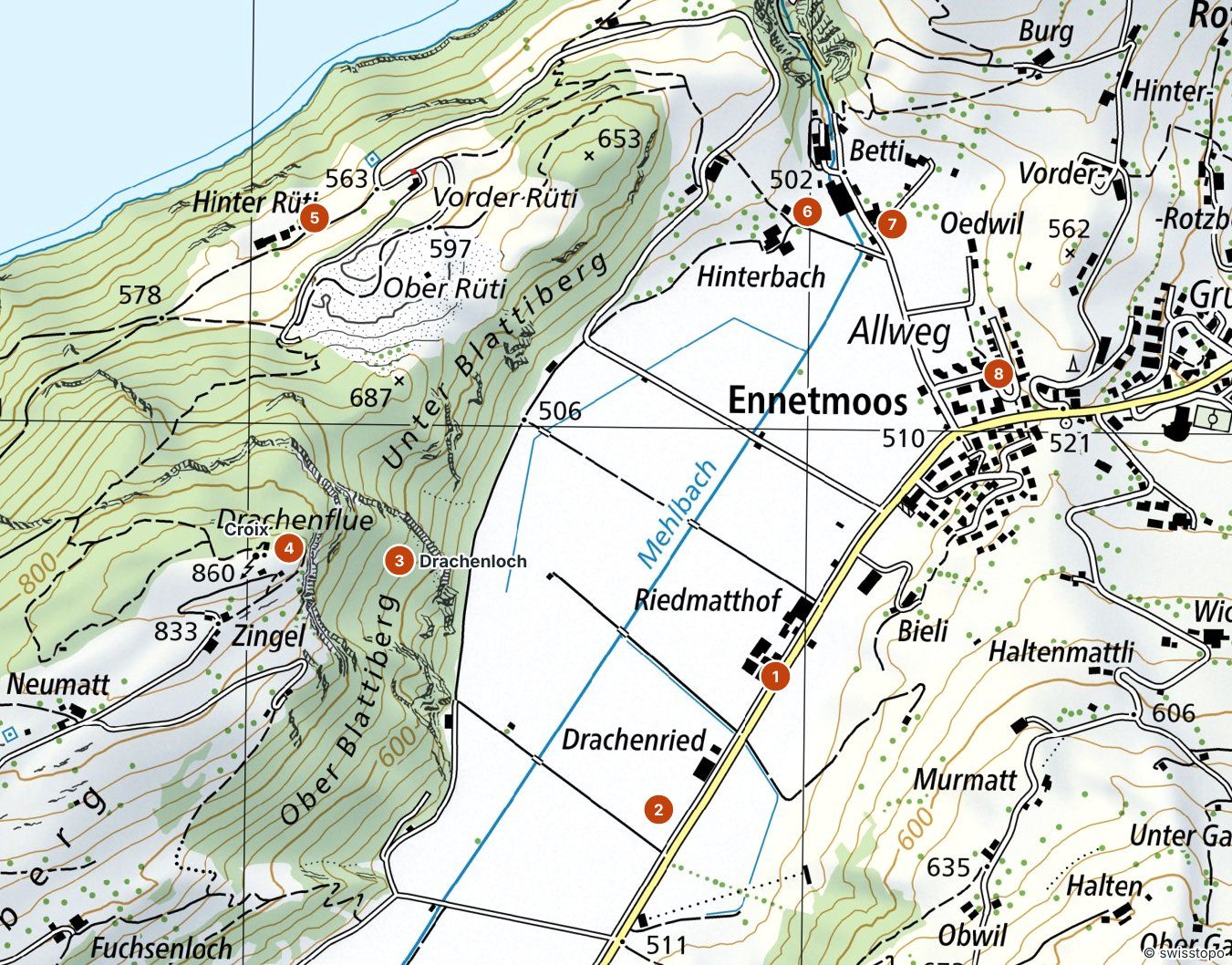
- 1RiedmatthofArrival by bus from Stans. The little self-service farm shop.on foot: straight across the plain
- 2DrachenriedThe former marsh, its ditches and the ruler-straight Mehlbach.on foot: steep forest below the cliff
- 3DrachenlochThe cave, unsignposted, at the foot of the Drachenflue.on foot: climb through the forest, below an antenna
- 4The cross, 860 mThe top above the Drachenflue, next to the Zingel. View over Lake Alpnach, Pilatus and the Drachenried.on foot: down through the meadows
- 5RütiAbove Lake Alpnach.on foot
- 6HinterbachA hamlet at the foot of the hill.on foot
- 7BettiAt the top of the Rotzloch gorge.on foot
- 8AllwegThe bench near the monument. Bus to Stans.
The places in the chapter
The Drachenried and the Riedmatthof
In the book: first scene
The plain west of Ennetmoos used to be a marsh: “Ried” means a wet meadow. The Mehlbach crosses it in a straight line, then plunges into the Rotzloch gorge. By the road, at the Riedmatthof, a little self-service farm shop sells cheese, apples and eggs.
The Drachenflue and the Drachenloch
In the book: first scene
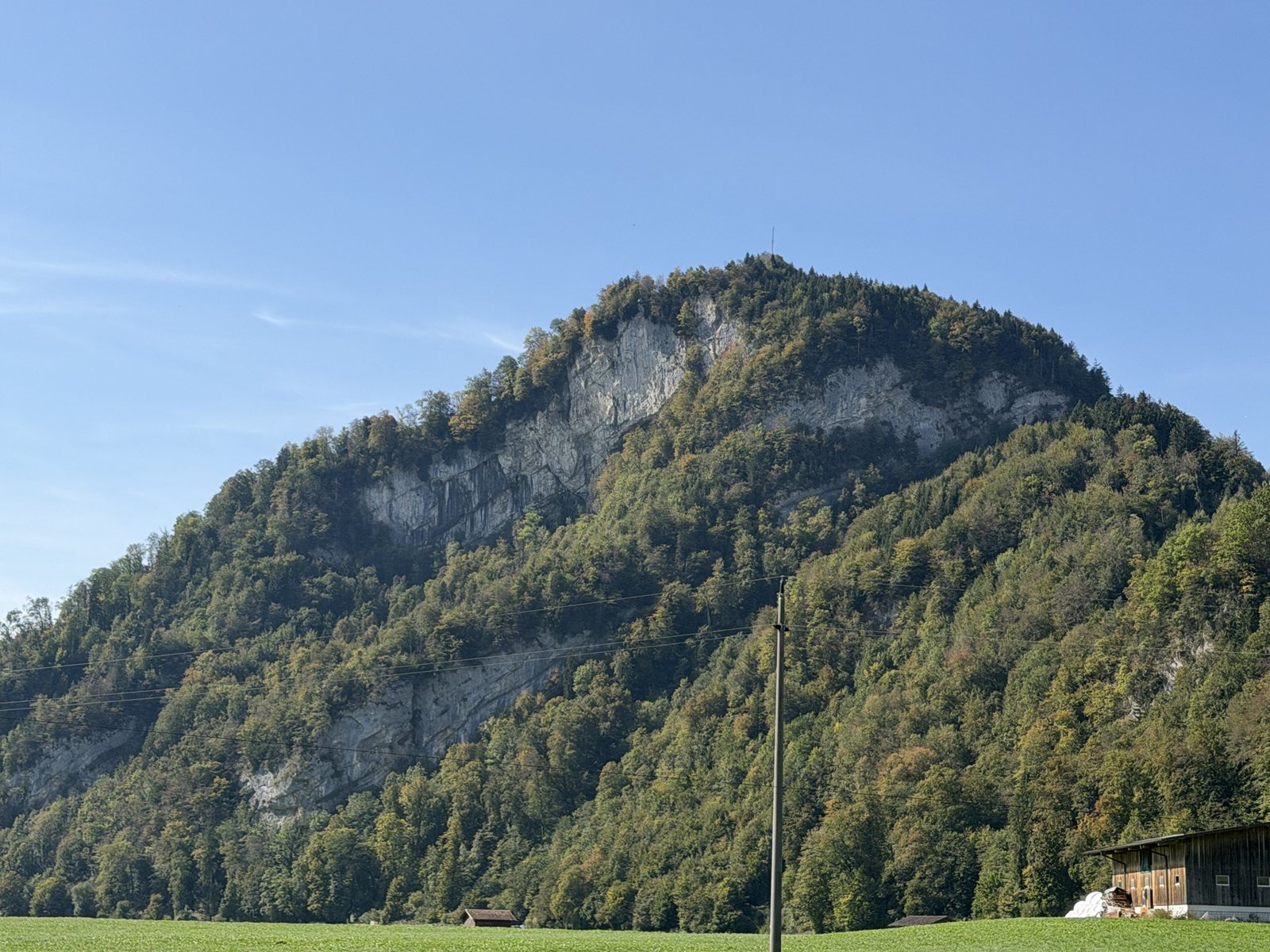
The Drachenflue, “the dragon’s rock”, is the cliff of the Mueterschwandenberg above the Drachenried; the neighbouring summit is called the Zingel. The Drachenloch cave opens at the foot of the rock face, hidden by the trees. According to the legend, this is where the Lindwurm killed by Struthan Winkelried lived (see chapter 5).
The cave is not signposted and the way up is steep and off the trail. In wet weather, it is better to enjoy the view from the plain or from the cross.
The engraving by Johann Heinrich Meyer
In the book: first scene
“Drachenhöhle beÿ Winkelriet”, the dragon’s cave near Winkelried: a small engraving drawn from nature in 1800 by Johann Heinrich Meyer for his series “Die Ruinen von Unterwalden” (Zurich, 1801). The original is kept at the Swiss National Library in Bern. In the book, Véronique discovers it at the cantonal library of Nidwalden in Stans.
The Stanserhorn
In the book: first scene
Opposite the Drachenloch rises the Stanserhorn (1,898 m). A funicular has climbed it from Stans since 1893, and the CabriO, an open-roof cable car, takes visitors standing in the open air all the way to the top.
The dragon stone (Drachenstein)
In the book: second scene
In 1421, according to the legend, the farmer Stämpfli sees a dragon fly from the Rigi towards Pilatus. He faints, and afterwards finds a stone inside a mass of clotted blood. His grandson sells it to a Lucerne physician, Martin Schryber, who has a certificate drawn up recording its origin and its powers. The stone is now on display at the Museum Luzern.
The cooper and the two dragons
In the book: second scene
In 1661 Johann Leopold Cysat tells the story of a Lucerne cooper who fell into a crevasse on Pilatus, between two dragons that did him no harm. In spring, he clung to the tail of one of them and was carried back up to the light. To thank heaven, he gave the Church of St Leodegar (the Hofkirche) an embroidered liturgical vestment showing his adventure. The Brothers Grimm included the story in their German Legends (no. 216).
In the Alps people also speak of the Tatzelwurm or Stollenwurm, a serpent with a cat’s head.
The markets of Lucerne
In the book: second scene
The weekly market is held on Tuesday and Saturday mornings along the Reuss, under the arcades of the Rathausquai and under der Egg. Above it, the town hall (1602–1606) wears an Emmental farmhouse roof on a Renaissance palace façade. On Saturdays from May to October, a flea market sets up at the Vögeligärtli.
The dragon ring
In the book: second scene
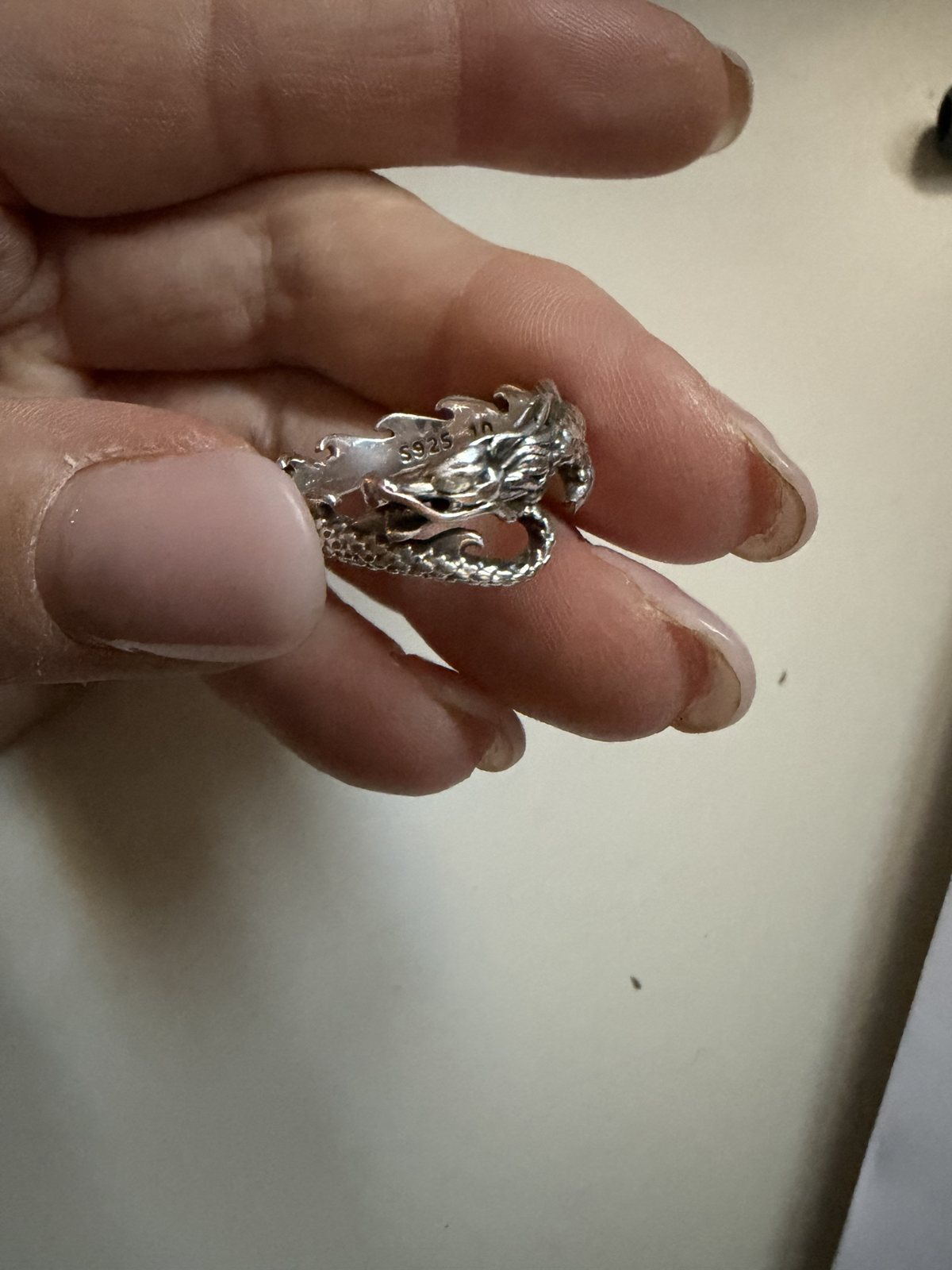
In the book, Véronique buys it at the flea market: a wingless silver dragon with a mane, whose origin nobody knows. She refuses to invent a story for it. The ring in the novel is inspired by a real ring belonging to the author.
True or invented?
The book mixes real places, old legends and invented scenes. Here is which is which.
Fact: verifiable (date, place, building). Legend: a traditional tale, told as such. Novel: created for the book.
Fact sheets to go further
Each legend and each topic will have its own full fact sheet, for travelling, discovering or doing research.
- The Drachenloch of Ennetmoos: legend, engraving, accesscoming soon
- The dragon stone of Lucernecoming soon
- The cooper and the two dragons of Pilatus, in fullcoming soon
- The Tatzelwurm and the serpents of the Alpscoming soon
- The dragons of Switzerland: the mapcoming soon
Sources
- J. H. Meyer, “Drachenhöhle beÿ Winkelriet”, 1800 (Swiss National Library, GS-GRAF-ANSI-NW-68)
- Johann Leopold Cysat, Beschreibung dess Berühmbten Lucerner- oder 4. Waldstätten Sees, 1661
- Brothers Grimm, Deutsche Sagen, no. 216
- Lucerne Tourism, the Pilatus legend (PDF)
- D. L. Ashliman, Dragons of the Alps
- Base map © swisstopo